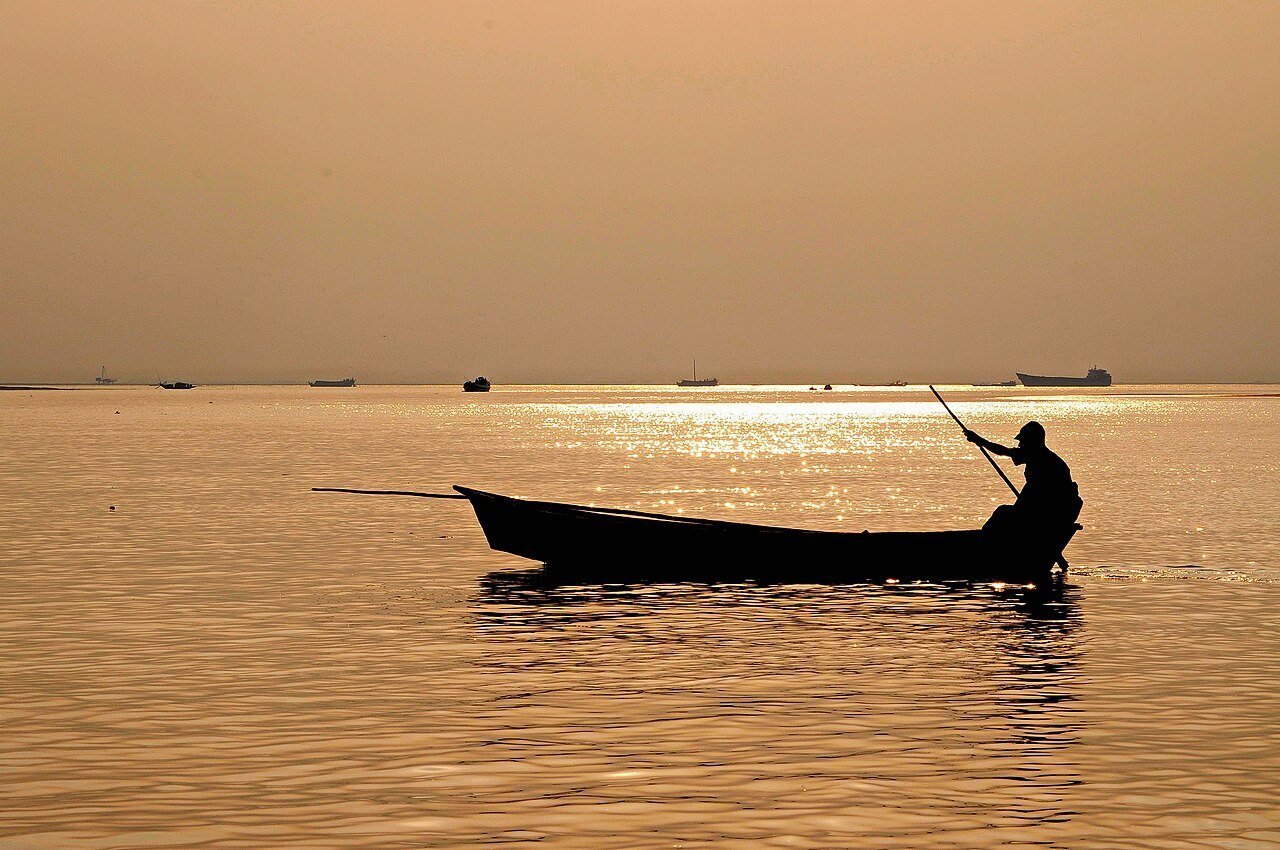
Few books say as much about life on the great rivers of Bengal as Padma Nadir Majhi (The Boatman of the River Padma). Its author, Manik Bandopadhyay, came from a family rooted in Bikrampur, the region whose southern edge is still shaped by the Padma. Published in 1936, the novel follows the fishermen of a riverside village: their debts, their quarrels, the floods that take their homes and the traders who profit from their work.
The story
At the centre is Kuber, a poor fisherman who struggles to feed his family. His life becomes tangled with Kapila, his wife's sister, and with Hossain Miya, a trader who is building a settlement on a distant island called Moynadwip and who draws villagers there with promises of land. The book treats Hindu and Muslim fishing families as neighbours who share the same river and the same hardship, and it is widely read as an unsentimental portrait of working people.
Manik wrote 38 novels and about 306 short stories before his death in 1956 at the age of 48. Padma Nadir Majhi has been translated into several languages, including English, Swedish, Russian and Italian.
The film
The Indian director Goutam Ghose adapted the novel as a feature film made as a joint venture between India and Bangladesh. It was shot entirely on location in Bangladesh, runs for about 126 minutes and was released in the early 1990s; sources give the year as 1992 or 1993. Raisul Islam Asad played Kuber and won the Bangladesh National Film Award for Best Actor for the role. The film also won the national award for Best Film, and Champa won Best Actress.
Critics at the time praised the photography of the river while some found the film slow. Ghose went on to make other literary adaptations, including Moner Manush (2010) on the life of Lalon.
Why it still matters in Bikrampur
The Padma described in the novel is the same river that today erodes land in Lohajang, and that is now crossed by the Padma Bridge. Fishing families along its banks still deal with seasonal bans, debt to traders and the loss of land to the river. For readers in Munshiganj, the book remains less a period piece than a familiar account of life by the water.
Sources: en.wikipedia.org, en.wikipedia.org, en.wikipedia.org, en.wikipedia.org